Even if the information in the following online post about the first ever lung transplant having been performed in Romania is only half correct, it is still of concern First-lung-transplant-Romania
It appears that an argument has been waged via social media by officials over whether or not the Sfanta Maria hospital in Bucharest had received the appropriate authorisation.
Regardless of who may or may not be correct here, this is no way to deal with this, for multiple reasons, not least maintaining public confidence in the hospital system. Hopefully the issues that are alluded to in the article will be addressed and most importantly the war of words via social media will cease.
Meanwhile it does seem that the first transplant in Romania has actually been performed. Of note up until recently lung transplants for Romanian citizens were performed in Vienna, Austria (as mentioned in the article).
For information on the actual lung transplant procedure as it was reported in Romania, click on the following link -Lung transplant at Sfanta Maria hospital
Musings of a transplant surgeon on organ donation and transplantation. Sharing information on these topics as well as on COVID19.
Why visit this Blog?
Conveying useful healthcare system information, including for organ donation and transplantation, as well as a social media emphasis.
Showing posts with label social media. Show all posts
Saturday, April 21, 2018
Saturday, October 27, 2012
Using Social Media for information streaming in healthcare
Are you in
health care and accessing social media for work purposes? Are you also comfortable
with using some of the current social media platforms as
tools for the streaming of information that meets your needs? If so, the following information is probably not new. However, if you do not fit in either of these two categories, then feel free
to read on.
The amount of
information related to health care is burgeoning whether it be in the form of
facts, published scientific reports, or related to other day to day work
processes. Much of this information is now sourced electronically including via the Internet. This situation has not gone unnoticed in some areas with there being an
increasing realisation that somehow all of this needs to be managed. At times
individuals can feel like they are "trying to drink from a fire hydrant" (Mitchell Kapoor) as
pictured.
This same analogy was featured in a blog written by a medical student in Scientific American Blog-Unofficial Prognosis where the impact of this information deluge on medical students was explored.
So how can
you use social media to help with your information needs regardless of where
you are in the health sector? Plus why might this now be an increasingly important topic?
First you need to gain familiarity with use of the most common social media
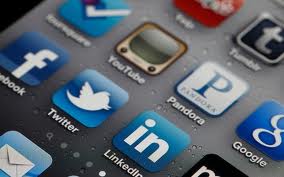
platforms which include Facebook, Twitter, YouTube and Linked In (see below image). Then
you need to ascertain which organizations, groups and individuals are relaying
information via these platforms which can help meet your learning needs. As it turns out an increasing number of organizations are relaying important information via social media.


For example
if you have recently joined Twitter but still feel a little unsure of how to go about finding the organizations or individuals of interest, the good news is that
help is at hand. This is in the form of the Symplur hashtags
project- @healthhashtags Via this Symplur web site you
can find hashtags including for organizations, communities of practice(eg nursing, medicine, audiology), diseases, treatments, management and informatics.
As a result of exploring the hashtags you will also be able to find relevant
organizations, plus individuals on Twitter as well as their related web sites and
other social media channels. As everyone has slightly different learning needs in health care, this is why it is now important that you know how to source useful information for yourself.
Finally feel free to explore, find like minded individuals and most important of all continue to learn! Also take some time to check out advice that is available on the safe use of social media platforms eg for Facebook via reputable channels including Mashable Social Media.
Tuesday, August 7, 2012
Organ Donation: Three essential 'A's.
You may notice
that the postings on to this site mainly provide information on 3
topics - organ donation, organ transplantation and use of social media. So what
would you say it you were told that there are important common messages contained
within these topics? What does this represent? Well it comes down to three
important words all beginning with ‘A’.
A is for
Awareness, a term
used frequently over the last 10-20 years for various campaigns promoting organ
donation around the world. So do you think that having lots of ‘Awareness’
leads to higher organ donor rates? What would you say if you were told that the
country with the highest organ donor rate in the world-Spain- does not run
‘awareness’ campaigns? Can you say that you or your family are truly aware of
the importance of organ donation or what is involved? How about your friends or
work colleagues? What steps have you taken to find out more about organ
donation even though you may be ‘aware’ of its importance? This is where one
other word beginning with ‘A’ becomes important.
A is for
Action, a term used when
individuals or organisations take steps to convert their ‘Awareness’ of a
problem or issue into steps that lead to real change and hence results. Without
taking action ‘Awareness’ on its own will not achieve any lasting impact.
Probably the greatest example of awareness not leading to appropriate action
for health is the world-wide obesity epidemic. Despite clear documentation of
an increasing problem for e.g. CDC statistics, numerous campaigns via both media
and professional organisations including, reports from the Institute of Medicine, the problem continues.
You can view an Obesity info graphic from the Australian Science Media Centre
which outlines the projected rates of obesity in that country if action is or
is not taken.
So what do
you need to do to take action on organ donation? Well first you need to find
out the facts and there are a number of good web sites which include Organdonor.gov,
United Kingdom NHS Then you need to
talk to your family. You can also note your decision via your Facebook timeline if you wish. If you belong
to an organisation with an interest in organ donation, then you will be
combining Awareness with Action which are two essential components as depicted
in order to help form a platform for leading and driving change
A is for
Advocacy, a term used
to signal the action being taken by individuals, groups or organisations who
want change [or reform] to occur, including within the health care system and at policy level, for the
barriers to organ donation to be overcome.
![]() |
| Three essential A's required for change |
So there you
have it, the 3 A’s as they relate to organ donation as depicted above, which is of enormous
importance for organ transplantation. You cannot have one without the other two.
As for social media, well this is now a conduit via which relevant information
[for both Awareness and Action] is being relayed both by
individuals and organisations with an Advocacy role. This is in order to facilitate the changes that are required in many countries to ensure that the maximum benefits of organ donation are realised.
Friday, January 20, 2012
Why should I use Twitter, as a healthcare worker?
How often do I hear comments being made about Twitter including the 'it is for socialising with celebrities' statement. If this was truly the case this blog would not need to be written nor posted! If you know all about Twitter you do nor need to read on, for everyone else here are some facts plus tips.
The use of social media in health care is now very much on the increase as outlined in a recent posting on the popular medical blog KevinMD . So hoping that you can continue to ignore this major trend, is probably no longer useful.
Twitter has become a conduit for relaying information rapidly around the world and is increasingly being used not only by individuals but a number of organisations. Here are some of examples of organisations who all use Twitter- governmental Food and Drug Administration , VicHealth , United Kingdom National Health Service , international organisations World Health Organisation , OECD , professional entities Kings Fund , American College of Surgeon, universities Harvard University , Imperial College , hospitals Mayo Clinic , Kings College Hospital , and medical journals New England Journal of Medicine , Lancet. Also in the public health arena Twitter has been used for 'tweeting' out information on policy Centres for Disease Control , APHA , new developments Johns Hopkins Public Health and evolving health issues CDC Social Media
So what use is this information for you? Well by joining onto Twitter you can elect to follow some of the organisations or entities that relay practical, useful information that you already know about. Look out for the Twitter symbol which is usually a small blue bird icon or a small blue 't' on their web sites and by clicking on that logo, you can then become a follower. Then by checking on your own home page on Twitter you can view all of the tweets of everyone you follow. The information contained in these tweets plus their accompanying links onto web pages may be useful for ongoing learning activities and adding to your knowledge base.
By trial and error you can also find other organisations you may wish to follow by entering relevant words into the Twitter search tool bar. If you find yourself following someone or something that is not particularly useful you can always unfollow! Guides on how to use Twitter are available on the Internet and the Mashable guide is one of the more popular currently.
How about actually 'tweeting'? Remember what you tweet is immediately in the public global Internet sphere, so anyone can potentially see it. Think before you write and even more importantly before you click on send! One unfortunate tweet can have major, major implications. There are guides available for the use of social media in the health sector. Examples include from the Australian Medical Association , and the British Medical Association . Your employer may also have a social media policy which you need to be fully aware of.
So what now? You can try joining up onto Twitter and start following what interests you. Whether you wish to tweet is up to you and please remember there are rules. Information contained in this recent Cool Info graphic , and the Jeffbullas Blog very much confirm that the use of social media is on the increase. So even if you are currently not accessing Twitter, there is a very good chance that people you know are. Good luck!
The use of social media in health care is now very much on the increase as outlined in a recent posting on the popular medical blog KevinMD . So hoping that you can continue to ignore this major trend, is probably no longer useful.
Twitter has become a conduit for relaying information rapidly around the world and is increasingly being used not only by individuals but a number of organisations. Here are some of examples of organisations who all use Twitter- governmental Food and Drug Administration , VicHealth , United Kingdom National Health Service , international organisations World Health Organisation , OECD , professional entities Kings Fund , American College of Surgeon, universities Harvard University , Imperial College , hospitals Mayo Clinic , Kings College Hospital , and medical journals New England Journal of Medicine , Lancet. Also in the public health arena Twitter has been used for 'tweeting' out information on policy Centres for Disease Control , APHA , new developments Johns Hopkins Public Health and evolving health issues CDC Social Media
So what use is this information for you? Well by joining onto Twitter you can elect to follow some of the organisations or entities that relay practical, useful information that you already know about. Look out for the Twitter symbol which is usually a small blue bird icon or a small blue 't' on their web sites and by clicking on that logo, you can then become a follower. Then by checking on your own home page on Twitter you can view all of the tweets of everyone you follow. The information contained in these tweets plus their accompanying links onto web pages may be useful for ongoing learning activities and adding to your knowledge base.
By trial and error you can also find other organisations you may wish to follow by entering relevant words into the Twitter search tool bar. If you find yourself following someone or something that is not particularly useful you can always unfollow! Guides on how to use Twitter are available on the Internet and the Mashable guide is one of the more popular currently.
How about actually 'tweeting'? Remember what you tweet is immediately in the public global Internet sphere, so anyone can potentially see it. Think before you write and even more importantly before you click on send! One unfortunate tweet can have major, major implications. There are guides available for the use of social media in the health sector. Examples include from the Australian Medical Association , and the British Medical Association . Your employer may also have a social media policy which you need to be fully aware of.
So what now? You can try joining up onto Twitter and start following what interests you. Whether you wish to tweet is up to you and please remember there are rules. Information contained in this recent Cool Info graphic , and the Jeffbullas Blog very much confirm that the use of social media is on the increase. So even if you are currently not accessing Twitter, there is a very good chance that people you know are. Good luck!
Subscribe to:
Posts (Atom)